
CitySalt Church

Celebrate Goodness
  • Upcoming
  • About
    • Services
    • Sunday Sermon Series
    • Directions
    • CS Staff
    • What is Co-Pastoring
    • Contact
    • History
    • Affiliation
  • Media
    • Sermon Audio Library
    • Salt Blog
    • Facebook
  • Ministries
    • Kids
    • Prayer
    • Kindness Fund
    • Serving
  • Give
  • Facility Rental
  • Upcoming
    • Services
    • Sunday Sermon Series
    • Directions
    • CS Staff
    • What is Co-Pastoring
    • Contact
    • History
    • Affiliation
    • Sermon Audio Library
    • Salt Blog
    • Facebook
    • Kids
    • Prayer
    • Kindness Fund
    • Serving
  • Give
  • Facility Rental

Salt Blog

  • Sermon Audio Library
  • Salt Blog
  • Facebook
  • All
  • Aaron Friesen
  • Allie Hymas
  • Betty Fletcher
  • BibleProject
  • Britni D'Eliso
  • Chris Carter
  • Darla Beardsley
  • Denise Jubber
  • Dusty Johnson
  • Isaac Komolafe
  • Jessie Carter
  • Jessie Johnson
  • John Rice
  • Joseph Scheyer
  • Kayla Erickson
  • Kaylee Luna
  • Kim Phelps
  • Laura Rice
  • Lauren Watson
  • Lee Schnabel
  • Leona Abrahao
  • Mark Beardsley
  • Mike D'Eliso
  • Mike Wilday
  • Mollie Havens
  • Music
  • Pam Sand
  • Randi Nelson
  • Resources
  • Ruth Vettrus
  • Sara Gore
  • Sara-Etha Schnieder
  • Sarah Moorhead
  • Sarah Withrow King
  • Shelby Tucker
  • Special Announcement
  • Steve Mickel
  • Sunday Service
  • Tenisha Tinsley
  • Terry Sheldon
  • Ursula Crawford
  • Zeke Wilday

Learning to Pray | What is Prayer? You tell me!

John Rice March 13, 2026

Following CitySalt’s recent sermon series on prayer, the blog team is leaning in to share our own perspectives and learnings on the topic. Join us as we explore personal discoveries of what prayer is and what it was never intended to be, and we pursue deeper alignment with how God invites us to communicate with him. 


As a kid growing up in an Episcopalian home, I learned two prayers. Not more, not less, not ever venturing off into the unknown of conversational prayer. Rote. Memorized. Genuine, I think, but said so often that you didn’t really need to think about what you were praying. One was said before supper and this prayer was always said by my father. It went, “Please God bless this food to our use and us to Thy service, for Christ’s sake. Amen.” Nice. Short. No real thanks for the food, but hoping that it might help us be healthy so we could serve God (who knew what that meant?!). The second prayer was at bedtime when we were taught to pray for ourselves, “Now I lay me down to sleep. I pray the Lord my soul to keep. If I should die before I wake, I pray the Lord my soul to take.” Oh, Lordy. Every night we reminded ourselves that we were going to die, and maybe it’s even tonight! I guess you could call that a fear-based prayer.   

The next prayer I learned before my full confirmation into God’s Episcopal family was the Lord’s Prayer. Again, memorized and kind of rote, but beautiful and meaningful nonetheless. The “Our Father…”, I’m sure you all know this one so I won’t repeat it.

So these are what I thought of as prayer until I was 18 years old when I was introduced to the living Jesus, accepted him and started to go to church to learn more about him. Pretty quickly I entered the world where you asked God for things: if you needed something (more money) or hoped for a certain outcome (a passing grade in your Math class) or wanted your sick friend or grandmother to be healed (from anything from a cold to a deadly disease). These prayers were based on scriptures like: 

Matthew 21:22
If you believe, you will receive whatever you ask for in prayer.

Mark 11:23
I tell you the truth, if anyone says to this mountain, ‘Go throw yourself into the sea’, and does not doubt in his heart but believes that what he says will happen, it will be done for him.

James 5:16
The prayer of a righteous man is powerful and effective.

These are the kinds of prayers I prayed until reading a book in the 1990’s entitled Listening Prayer by Leanne Payne. Learning and practicing prayers that weren’t necessarily about asking God for something (though that could still be part of it), my wife and I started to expect God to speak to us if we only would wait and actually listen for a response. This was a radical shift and greatly increased our faith in, and closeness to, God. This expanded our awareness of God’s presence with us at all times and all places. This kind of prayer, added to the intercessory kind, established a genuine conversation with God. It was a wonderful revelation! But I remember one time long after we’d been practicing this kind of listening prayer, when I asked God for his council on something and I was waiting to hear his answer. What I heard him say to me was, “Well, what do YOU think😊”. I include a smiley face because I heard this with a light-hearted attitude on God’s part, wanting to teach me that he’d given me the ability to reason things out and that whatever decision I made, he’d be with me to guide the next step and teach me from the experience. That was empowering!

Then there came a very difficult time in my life when I felt spiritually depleted, unable to read the Bible with any openness, or to pray with any conviction. Too many prayers had gone unanswered. A wise counselor encouraged me to simply “float in the sea of grace”, not attempting to read, craft prayers or do anything else. This was so powerful and just what I needed to recognize that God is always with us, upholding us in his grace, no matter how well or passionately we prayed. In fact, this silent floating became the prayer itself. Oh, how freeing and expanding that was…and still is.  

Another profound teaching I was introduced to proclaimed that God’s Creation was actually the “first gospel”. Before Jesus came in bodily form to this earth, the whole universe, including the heavens, the earth, the waters, the animals and we humans proclaimed the glory of God:       

Psalm 19:1-4 
The heavens declare the glory of God; the skies proclaim the work of his hands. Day after day they pour forth speech; night after night they display knowledge. There is no speech or language where their voice is not heard. Their voice goes out into all the earth, their words to the ends of the world. 

For many, simply walking out in the woods, camping in the mountains, swimming in the ocean, watching the sunrise… all these things are prayers if you acknowledge the presence of God as the Creator of all things. I believe he delights in the times we delight in his natural creation.

The point of this blog entry is really to contend that prayers, like so many spiritual practices, are not black or white, right or wrong, good or bad. Prayer is simpler than that. It is just finding the best way to commune with God at any particular season in our lives. Don’t judge it! Experiment with different forms of it! Practice whatever allows you the most closeness to the God who loves you!


About the Author

John lives in Pleasant Hill with his dog, Gunnar, and a multitude of guests who enjoy the peace and beauty of the Cascade foothills. With three children and three grandchildren all living in Oregon, he is continually blessed with their company and the good food that always accompanies their get-togethers!


In John Rice Tags Learning to Pray, Practice, grace, Listening
Comment

Loving Our Enemies Within | God’s Grace is Our Superpower

John Rice July 18, 2025

Imagine yourself as a beautiful, unique clay bowl when you were born. You were one of a kind. Your shape, your color, your size were all very special and you were deeply loved, appreciated and cared for by your parents. As you started to grow older you noticed that you were different from all the other kids. A few of those kids didn’t like your different qualities and they seemed jealous or afraid of you, so they called you names and excluded you from their games. This hurt. You might have started to think that they had good reason to not like you, like maybe you were unworthy of their admiration. This all had the effect of knocking a chip out of the beautiful pottery bowl that was yourself.

Sometime later, you were frustrated because you needed something that you couldn’t afford, but someone you knew had this thing and you figured that they didn’t really need it like you needed it. So you stole it. Your conscience felt a little bad about it, but you were able to push those thoughts down in your mind…at least mostly. You noticed something like a small crack in the side of your bowl.

Then someone you loved moved far away or even died. This was like a big crack in your bowl, so big that a part of your bowl broke off and shattered. Because of this loss, you felt so bad that you tried taking drugs to ease the pain and before you knew it, you felt you couldn’t live without these drugs. You were addicted and your life really started falling apart. There were more and more cracks in the beautiful bowl that once seemed so perfect. If you believed in God, you were pretty sure God had allowed all these things to happen to you because you weren’t the good person God wanted you to be. This life, and these cracks, were punishment for your imperfections and your failings. Your clay bowl was so cracked that you thought it was useless and ready for the junk pile.

But God apparently had a different plan. Rather than judge and punish you for your bad choices and painful experiences, He began to fill in all those cracks and shattered pieces, mending them so that your bowl was restored, still useful and possibly even more beautiful than before! And not only did He repair the gaps and missing pieces, He did it with the costliest materials.

This image of you as a once perfect, then broken, and finally restored clay pot is a spiritual dynamic found in the Bible…it’s called grace.

Japanese craftsmen employ an ancient technique called “Kintsugi” to repair broken clay pots and bowls. It fits with their philosophy that just because something breaks, it shouldn't be thrown away but rather restored. This is honoring the original by giving it new life. And the new bowl or pot has an extra special dimension, having been restored with precious materials like gold or silver.

The kintsugi technique reminds me of God’s working to restore us by His grace. Grace is defined as undeserved favor. We can’t restore ourselves by our willpower and strength alone. It’s a gift of God’s grace, as Paul mentions in his letter to the believers in Ephesus:

Ephesians 2:8
For it is by grace you have been saved, through faith – and this is not from yourselves, it is the gift of God – not by works, so that no one can boast. For we are God’s handiwork, created in Christ Jesus to do good works, which God prepared beforehand for us to do.

How amazing that God saves us! He restores us! He transforms us! And it not only benefits ourselves…it’s for the purpose of blessing others and to make the world a better place, “to do good works which He prepared beforehand for us to do.”

Here are some pictures of bowls restored with the Kintsugi process:

kintsugi1-1500-sq.jpg
kintsugi2-1500-sq.jpg
kintsugi3-1500-sq.jpg

Be blessed! The only thing required to have this beautiful and valuable restorative process take place in your life is to receive the grace God is pouring into you. Look for it!


About the Author

John lives in Pleasant Hill with his dog, Gunnar, and a multitude of guests who enjoy the peace and beauty of the Cascade foothills. With three children and three grandchildren all living in Oregon, he is continually blessed with their company and the good food that always accompanies their get-togethers!
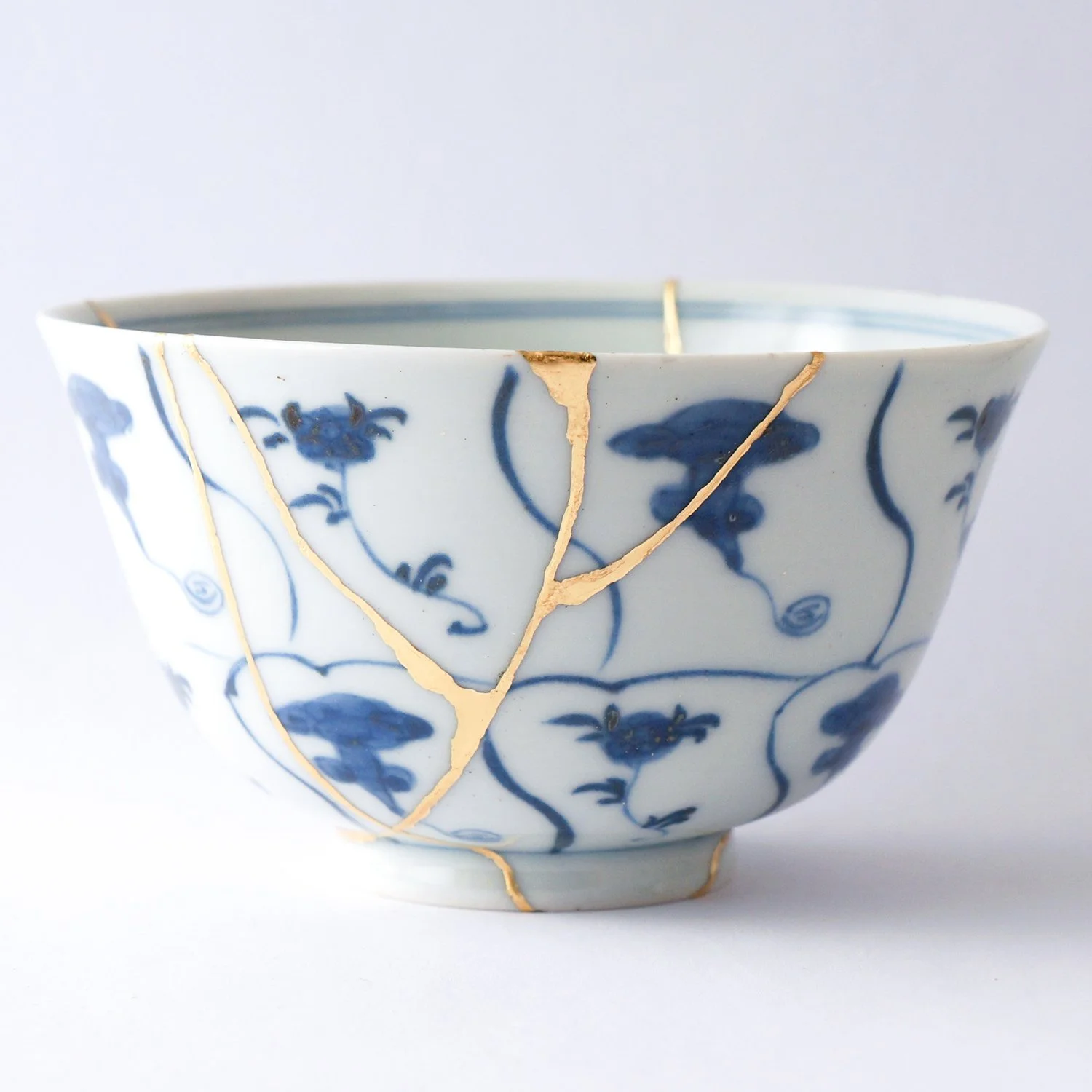
In John Rice Tags Loving Our Enemies Within, Cracks, Kintsugi, Restore, Valuable, grace
Comment

The Joy of Being Human | Relax in Grace

Mollie Havens August 25, 2023

A big part of being a Christian is to just enjoy being a child of God and know that you are saved. You are not saved because of anything you’ve done but because of grace. Ephesians 2:8-9 says, “For it is by grace you have been saved, through faith, and this is not from yourselves, it is the gift of God, not by works so that no one can boast.” Because of this we can relax in Christ. This does not mean that we do not try to be a good person, it just means that we do not have to be perfect.

For me it is hard to not try and be perfect. If you ever heard of the Enneagram, then you will know that the “achievers’ (Type 3) try very hard to be perfect and won’t be satisfied with anything less. Because of this, they can be workaholics and dedicated to doing things right. I often feel defined by my achievements. I am goal oriented and can find my worth in my accomplishments. I am driven and find it hard to relax. I have a difficult time napping and turning my mind off. I have a type A mentality and a strong drive for self improvement. I have a fear of failure and not measuring up. Because of this, I have a hard time accepting that God's grace is enough. I try to earn my salvation and be as good as I can be, instead I need to learn how to lie back into the arms of grace and know his love enough.

But just because we have grace does not mean we can slack off. James 2 talks about how faith is alone is not enough. It needs to produce good deeds. If it doesn’t, then it is dead and useless. So we need to find the right balance of doing what is right and basking in the grace of God. And on this journey, we can also remember that there is nothing we could ever do to make God stop loving us. We need to find that right balance of being good for the right reasons, not to earn God’s love or salvation but to be the person God inspires us to be, a person after God's own heart.

In Romans 8:29-30 Paul explains that “those whom He foreknew [and loved and chose beforehand], He also predestined to be conformed to the image of His Son [and ultimately share in His complete sanctification], so that He would be the firstborn [the most beloved and honored] among many believers. 30 And those whom He predestined, He also called; and those whom He called, He also justified [declared free of the guilt of sin]; and those whom He justified, He also glorified [raising them to a heavenly dignity].” It is tempting to get so caught up in the fact that God calls us to a great purpose that we forget that he has justified us and glorified us. He has sanctified us, saved us and given us salvation before we even discover our calling. As soon as we believe in Him, he gives us grace which grants us the power to find that purpose he has called us to. So work hard at that purpose that God has destined you for but don’t forget to relax in His gift of love, peace, joy, hope and grace that he lavishly bestows on his children.


About the Author

Mollie is recently married to her wonderful husband Dustin. She is a Wound Care RN at McKenzie Willamette Hospital. She enjoys being creative, getting outdoors and spending time with friends and family.

In Mollie Havens Tags The Joy of Being Human, Perfectionism, grace
Comment

Sidebar Title (H3)

Morbi leo risus, porta ac consectetur ac, vestibulum at eros. Curabitur blandit tempus porttitor. Curabitur blandit tempus porttitor. Vestibulum id ligula porta felis euismod semper. Vivamus sagittis lacus vel augue laoreet rutrum faucibus dolor auctor. Fusce dapibus, tellus ac cursus commodo, tortor mauris condimentum nibh, ut fermentum massa justo sit amet risus.

*This sidebar is displayed on all blog pages. It will render on both the list and item views of each blog you create.

email facebook-unauth
  • Home
  • Directions
  • Sermon Library
  • Service Volunteer Interest Form
  • Give

CitySalt  | PO Box 40757 Eugene OR 97404 | (541) 632-4182 | info@citysalt.org

Copyright 2023, all rights reserved.

CitySalt Church

Celebrate Goodness

CitySalt Church | 661 East 19th Avenue, Eugene, OR, 97402, United States

email facebook-unauth